 Panama City Beach Golf Cart Repair
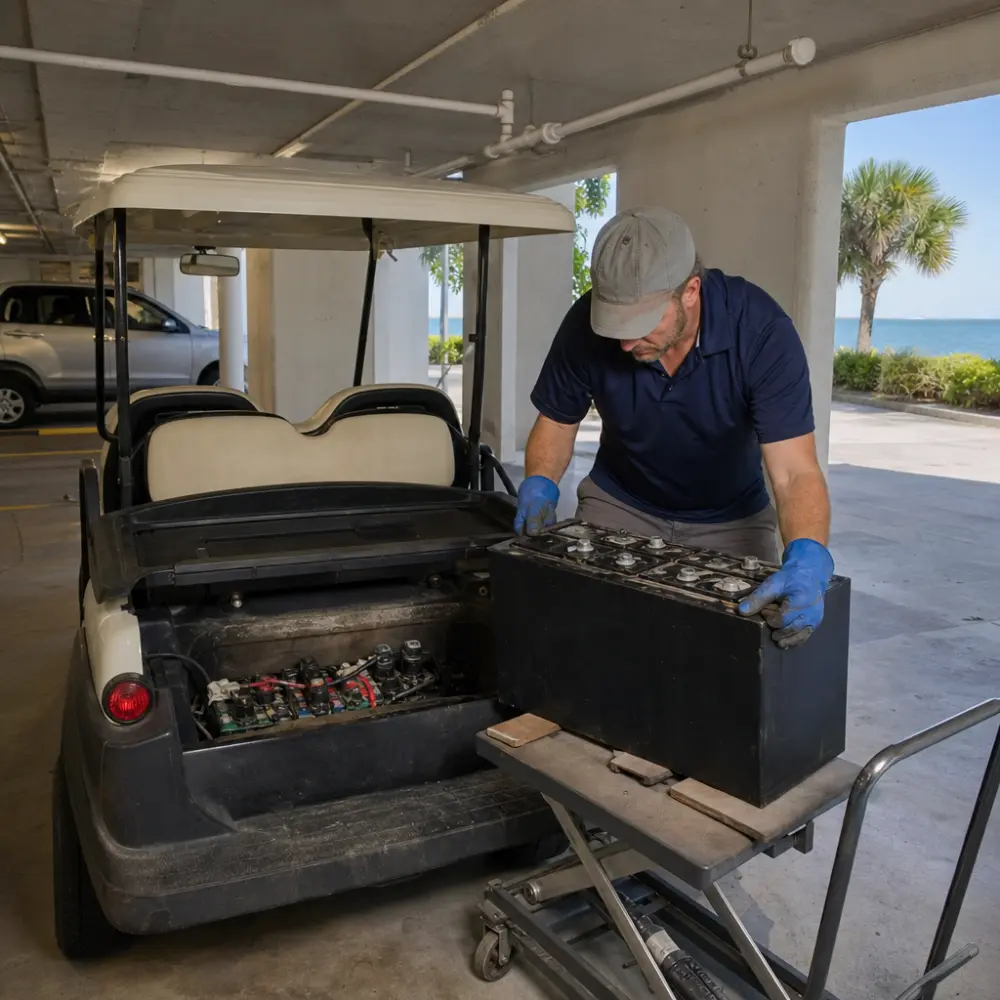
Panama City Beach Golf Cart Repair comes to your driveway, condo garage, or fleet lot anywhere in Panama City Beach and Bay County, and our techs repair the cart on-site: batteries, brakes, tires, chargers, solenoids, motors, controllers, and lights, on golf carts and street-legal LSVs alike. Expect $1,200 to $1,800 installed for a full lead-acid pack, $75 to $400 for brake work and $75 to $150 each for tires, with the $50 to $100 service call usually applied toward your repair. Describe the symptom by form so our tech can bring the likely parts; if one must be ordered, expect a second visit.
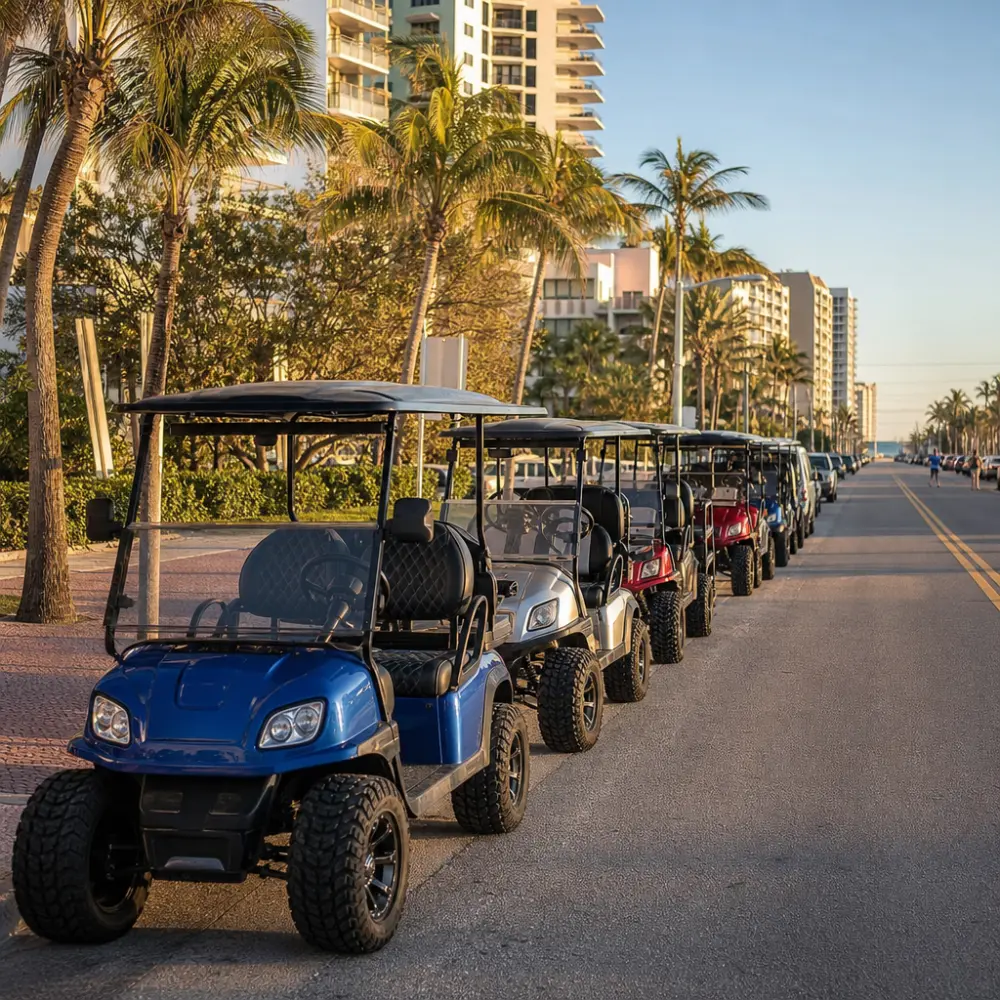
Panama City Beach is not a retirement town built around a cart path; it is a 13-mile-long tourist strip where the golf cart and the low-speed vehicle are how people get around a place with no property tax, a Business Tax Receipt economy, and a median household income of $80,941 built almost entirely on visitors. The 2020 Census counted 18,094 year-round residents, up from 12,018 in 2010, and the city’s own numbers put the 2024 population over 19,000 with growth projected near 16 percent by 2030, the fastest-growing spot in Bay County. None of that counts the carts. Between the private carts that come with a condo or a beach house, the fleets that rental counters run up and down Thomas Drive and Front Beach Road toward Pier Park all season, and the LSVs residents actually register and drive to the grocery store, this stretch of coastline puts more cart-hours on the road per mile than almost anywhere else in Florida we looked at. When one breaks down during a rental week or a holiday weekend, there is no time to trailer it anywhere. That is why everything here is mobile.
What gets fixed, at your home or fleet lot
- Mobile golf cart repair: the core service. On-site diagnosis and repair of whatever is wrong: will not move, will not charge, weak on the way back from Pier Park, clicking, cutting out. All major brands, electric and gas, golf carts and LSVs.
- Battery replacement: new lead-acid packs installed with haul-away of the old cores, plus honest lead-acid versus lithium math for carts that run every day of a Gulf Coast summer.
- Brakes and tires: we adjust brakes, swap shoes and drums, and mount new tires right where the cart is parked. Sand, salt air, and rental-fleet mileage all wear parts faster than the brochure assumes.
- Motor and controller repair: solenoids, speed controllers, and drive motors diagnosed with meters before anything gets replaced.
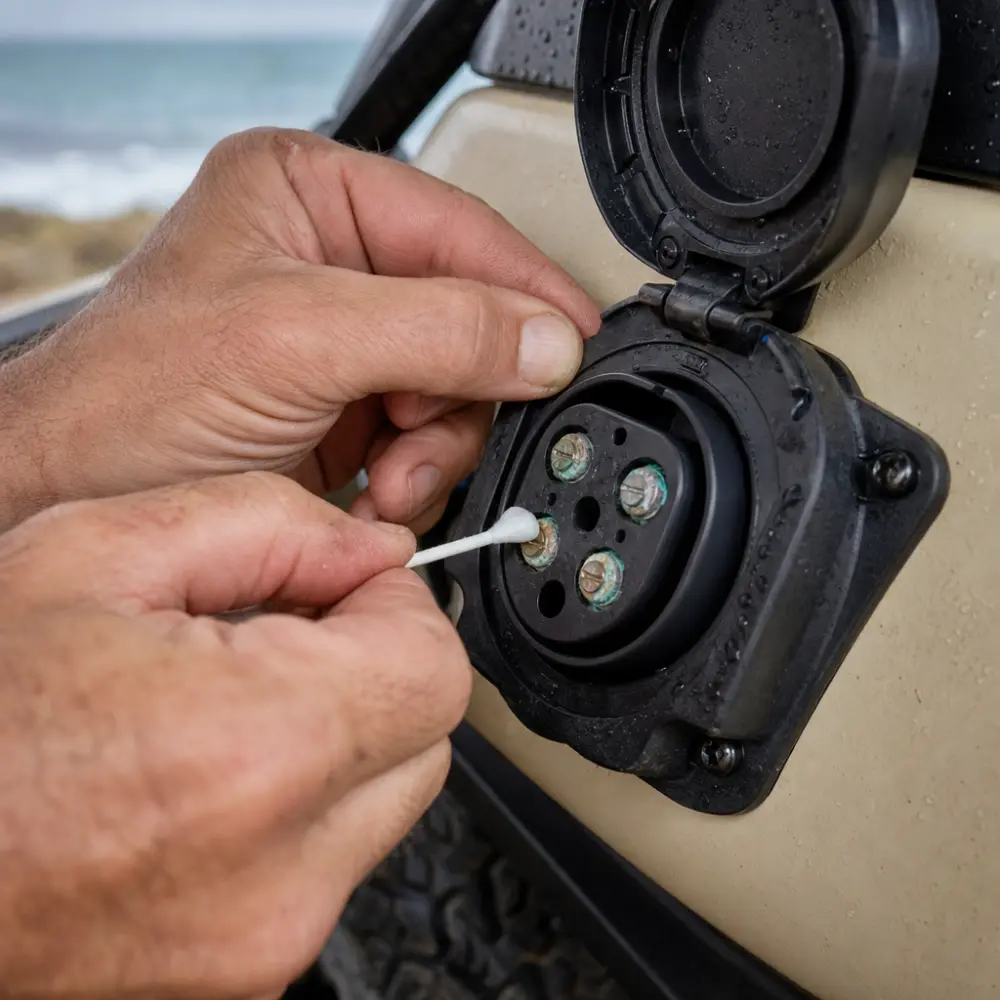
- Charger repair: carts that “will not take a charge” are often a charger, charge port, or corroded connection, not a battery problem. Insist on a test before buying anything.
- Tune-up service: the pre-season and post-storm annual: battery water and load test, terminal cleaning, brakes, tires, lights, and a corrosion check that matters more a few blocks from the Gulf.
- Lights and street-legal equipment: headlights, brake lights, signals, mirrors, and reflectors installed to what Florida law and Panama City Beach’s own LSV rules actually require.
Every range we charge sits on the pricing page in plain view. Competitors make you call for a number. Here you see it first.
Why Panama City Beach carts break the way they do
Salt air is the constant, not the exception. Nineteen and a half square miles of this city sit on the Gulf, and a cart that lives within a few blocks of the water spends its life in salt-laden air whether it ever touches sand or not. Terminals, cable lugs, and charge-port pins corrode faster here than in an inland town, resistance climbs, and a corroded connection mimics a dying battery pack. Part of every diagnostic is a voltage-drop check along the main cables before anyone talks about a new pack.
Heat runs long and hard. NOAA’s 1991 to 2020 normals for the Panama City 5N station put the July average high at 91.1°F and August at 90.9°F, and count 67.3 days a year at 90°F or above. Inside a flooded lead-acid battery, heat evaporates water out of the electrolyte faster, and once the level drops below the plates, the exposed lead sulfates and permanently loses capacity. A pack rated for five or six years of catalogue duty often runs shorter here, especially on a cart that sits closed up in a hot garage between rental weeks.
The duty cycle is unlike a retirement community’s. A private cart parked at a beach house might go out once a week in the off-season and every day in June and July. A rental fleet cart can rack up more discharge cycles in a single spring break week than a snowbird’s cart sees in a slow month elsewhere. Both patterns wear packs and brakes, just on different clocks, and both are reasons to test rather than assume.
Storm season changes the job. Hurricane Michael made landfall near Tyndall Air Force Base on October 10, 2018 as a Category 5 storm with sustained winds of 161 mph, the strongest hurricane landfall on record in the Florida Panhandle. Peak surge of 9 to 14 feet hit the Mexico Beach to Cape San Blas stretch; no published source we could verify gives a surge figure specifically for Panama City Beach, on the opposite side of the landfall point from where that peak was measured. Ahead of forecast weather, charger and battery work comes first, because a fully charged cart matters most when the power goes out. Afterward, on the coast, the common problem is saltwater intrusion in battery compartments; inland, chargers that took a surge when the power came back.
Golf cart or LSV: which one, and where
Panama City Beach’s own rules make the split plain. Under F.S. 320.01 a golf cart cannot exceed 20 mph and a low-speed vehicle (LSV) tops out above 20 but not above 25 mph, and the city’s guidance is that a golf cart should not be driven where the posted limit exceeds 25 mph. A titled, registered, insured LSV under F.S. 316.2122 may run on any street posted 35 mph or less, but the city specifically keeps LSVs off Panama City Beach Parkway (US 98, also called Back Beach Road) and Hutchison Boulevard (Middle Beach Road) entirely, no matter the posted limit there. Front Beach Road and Thomas Drive are the corridors most riders actually use, on the stretches posted at or under 35 mph. The full breakdown, with every section cited, is on our street-legal rules page.
Where the carts live
Thomas Drive and the Grand Lagoon area anchor the east end, wedged between the Gulf and the Grand Lagoon with water on both sides and a dense run of condos, rental units, and Naval Support Activity Panama City. West of the city center, Laguna Beach and Inlet Beach carry the route to the Bay-Walton line and 30A. Across the bay, Panama City runs its own golf cart program in twelve designated neighborhoods, and Lynn Haven sits just north of it. Callaway, next to Tyndall Air Force Base, and Mexico Beach, still rebuilding a generation after Michael, round out Bay County. Santa Rosa Beach in Walton County is the far western edge of the route, about 32 miles out via US 98.
How a mobile visit works
- Tell us the symptom. Will not move, clicks but no go, will not charge, sags on the way back from the pier, squeals when braking. A clear description usually points to the fault, which means our tech pulls up with the right parts on the truck.
- Our tech comes to you. Driveway, condo garage, or fleet lot, at a scheduled window. You pay a $50 to $100 trip fee that covers the diagnostic, and it usually comes off the repair bill.
- Diagnosis comes before any recommendation. Load test on each battery, voltage checks across the pack, charger output test, voltage drop along the main cables, solenoid and controller checks. The goal is the actual fault, not the most expensive maybe.
- Flat quote on the spot, fix on the spot. Battery sets, solenoids, brake shoes, and tires are the parts our techs most often bring along. Say yes to the number and, more often than not, the cart is running again before our tech leaves.
- Finish clean. Lead-acid packs get watered and terminals cleaned and coated, everything gets a torque check and a test drive, and old batteries leave with us for recycling.
Straight answers, published prices
Two things to know. We do not pretend to be something we are not: we are an independent service, not an authorized dealer or warranty center for Club Car, E-Z-GO, Yamaha, ICON, or Evolution. Warranty repairs on a newer cart belong with whoever sold it to you. And nobody should sell you parts you do not need. A cart that will not charge deserves a charger and charge-port test before anyone talks about a battery pack, and a weak cart deserves a per-battery load test before six batteries are condemned when one is the problem. If a repair does not make sense against the value of an old cart, we will say so.
The hands-on work is done by our own mobile techs. More on how we operate is on the about page, and the FAQ answers the questions owners ask most.
Get a fast quote
A cart that quits during a busy week on the beach is the call we answer most. Tell us the brand, model year if you know it, whether it is a 36V or 48V electric or a gas cart, and what it is doing. Snap the battery bay or the dash if you can; it saves a guess. We will come back with a flat number and a scheduling window, and the visit is fitted into that week’s schedule anywhere from Thomas Drive to Laguna Beach to Panama City; ask when you call.